










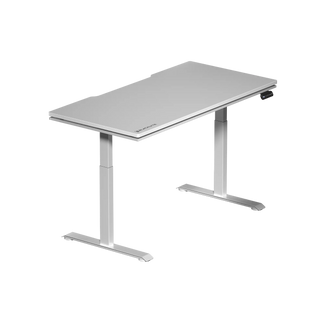


Standing desks have gone from niche ergonomic upgrades to genuine workspace essentials — and once you start shopping for one, you quickly run into a decision that trips up a lot of buyers: single motor or dual motor? Both power the same core action (raising and lowering your desktop at the press of a button), but the engineering differences between them have real consequences for stability, weight handling, noise, and long-term performance.
This guide breaks down exactly how single and dual motor systems work, where each one excels, and what the numbers actually mean for your day-to-day setup. Whether you're building a dedicated gaming station, a focused home office, or a hybrid workspace that needs to do both, understanding the motor difference is one of the smartest shortcuts to picking a desk that won't disappoint you six months after it arrives.
How Electric Height-Adjustable Desks Work
An electric height-adjustable desk uses one or more electric motors to drive a lead screw mechanism inside each desk leg. When you press the up or down button on the control panel, the motor rotates the lead screw, which extends or retracts the telescoping leg columns. The number of legs and the number of motors driving them is where the single vs dual motor distinction comes in.
Most modern electric standing desks are two-legged (or two-column) designs, meaning there are two lifting points supporting your desktop. In a single motor configuration, one motor drives both legs through a shared mechanical connection — typically a crossbar or a synchronized cable system. In a dual motor configuration, each leg has its own dedicated motor, operating in tandem via an electronic control system that keeps them synchronized. That difference in architecture shapes nearly every performance characteristic you care about.
What Is a Single Motor Standing Desk?
A single motor standing desk uses one motor to power the entire lifting mechanism. That motor is typically housed in the crossbar or one of the leg columns, and it drives both legs simultaneously through a mechanical coupling — usually a driveshaft that runs the width of the frame. Because the movement is mechanically linked rather than electronically synchronized, both sides lift at exactly the same rate, which sounds ideal on paper.
In practice, single motor desks are a solid entry-level choice. They tend to cost less to manufacture, which translates directly to a lower purchase price. They're simpler mechanically, which can mean fewer points of electronic failure over time. For light-to-moderate loads — a monitor, a laptop, some peripherals — a quality single motor desk performs the basic task reliably. The tradeoffs become more apparent as you increase the load on the desk or demand higher performance from the lifting cycle.
What Is a Dual Motor Standing Desk?
A dual motor standing desk places an independent motor in each leg column. The two motors are electronically controlled to operate in precise synchronization — modern desks typically use encoder feedback systems to ensure both sides rise and fall at exactly the same rate, preventing uneven loading and frame stress. Because each motor only has to manage one leg, both motors can operate closer to the middle of their power curve rather than being pushed to the limit when the desk is loaded.
The result is a system with higher overall torque, greater load capacity, better structural stability during movement, and typically a quieter, smoother lift cycle. Dual motor designs also tend to support greater height ranges and faster travel speeds, which matters more than it might seem — if you're switching between sitting and standing multiple times a day, a faster, smoother transition makes the habit far easier to maintain. This is the configuration that most professional and premium standing desk manufacturers default to in their higher-tier products.
Single vs Dual Motor: Key Differences Compared
Stability and Wobble
Stability is where dual motor systems pull ahead most noticeably. Because each leg has its own motor with active torque management, the frame maintains better rigidity under dynamic load — meaning your desk doesn't sway or wobble as much during the lift cycle or when you're leaning on it at standing height. Single motor desks rely more heavily on the physical rigidity of the crossbar and frame construction to maintain stability, which is adequate at lower heights but can introduce lateral flex on wider or taller desks, particularly above 100 cm.
If your setup includes a large ultrawide monitor, multiple displays, or any kind of mounted arm, stability during height adjustment becomes genuinely important. A wobbly lift cycle isn't just annoying — it creates mechanical stress on monitor mounts and cables with every transition, and that adds up over months of daily use.
Load Capacity
Single motor desks typically support static load capacities in the range of 60–80 kg, which covers most standard desktop setups with one or two monitors. Dual motor desks routinely offer 100–160 kg of capacity, sometimes higher in heavy-duty commercial configurations. This isn't just a spec-sheet bragging point. Exceeding the rated load capacity of a single motor system creates excessive heat in the motor, accelerated wear on the lead screw, and risk of triggering the thermal overload protection — which cuts power mid-lift and leaves your desk frozen partway through a height change.
For a gaming or professional workstation that includes a large desktop, dual monitors, a desktop PC, external drives, an audio interface, and a monitor arm or two, the weight adds up fast. Dual motor designs give you a meaningful safety margin and more consistent performance at the upper end of your load range.
Lifting Speed
The difference here is smaller than most buyers expect, but it's real. Single motor desks typically lift at around 25–30 mm per second. Dual motor desks often achieve 38–50 mm per second. Translating that into practical terms: crossing a 50 cm height range (from a seated position around 72 cm to a comfortable standing height around 122 cm) takes roughly 20–25 seconds on a single motor desk and 12–15 seconds on a fast dual motor system. That might not sound significant, but over dozens of transitions per week, it shapes whether height adjustment becomes an effortless habit or a mildly irritating wait.
Noise Levels
Both motor types have improved significantly in recent years, and a well-engineered single motor desk can be genuinely quiet. That said, dual motor systems generally operate with less mechanical strain per motor, which contributes to lower acoustic output during lift cycles. Budget single motor desks can emit a noticeable whirring or grinding tone under load, while quality dual motor systems often operate below 50 dB — roughly equivalent to a quiet conversation. If your workspace is shared, you're in a call during a transition, or you simply prefer a clean acoustic environment, this gap matters.
Long-Term Reliability
Fewer components sounds like an advantage for single motor systems, and in some ways it is. There's only one motor to potentially fail. However, that one motor carries the full burden of every lift cycle across the entire lifespan of the desk. Dual motor systems distribute that mechanical workload across two motors, each operating well within its rated capacity. Assuming quality motors and a reasonable daily usage pattern, dual motor systems often demonstrate better longevity at higher load levels precisely because neither motor is ever being worked close to its limits.
Build quality of the motor itself, the quality of the lead screw, and the robustness of the control electronics all matter enormously here — a quality single motor desk will outlast a cheaply built dual motor desk every time. The motor count is a meaningful indicator of engineering priority, not a magic durability guarantee.
Price Difference
Single motor desks are generally priced lower because they require less manufacturing complexity — one motor, simpler control electronics, no synchronization system to engineer or calibrate. The price gap varies significantly by brand and tier, but broadly speaking, dual motor models sit 15–30% higher in price compared to equivalent single motor options from the same manufacturer. In the premium segment, that difference narrows considerably as both motor configurations are paired with high-end frames, thicker desktop surfaces, and advanced control panels — and the overall value proposition of the desk matters more than the motor configuration alone.
Which Motor Type Is Right for You?
The right answer depends on what you're putting on the desk and how you intend to use it. A single motor desk makes sense if your setup is relatively light (under 60–70 kg of total load), you're working with a compact to mid-size desktop, your height range requirements are modest, and your budget is the primary constraint. For a simple laptop-and-monitor home office setup, a quality single motor desk is entirely capable of doing the job well.
A dual motor desk is the smarter investment if your setup includes multiple large monitors, a full desktop PC, heavy peripherals, or any mounted equipment. It's also the right call if you're switching between sitting and standing frequently throughout the day (the faster lift speed and smoother cycle genuinely support the habit), if desk stability matters to you at standing height, or if you're building a long-term workstation that you don't want to replace in two years. For serious gaming setups in particular — where large displays, high-end audio equipment, and heavy desktops are common — dual motor stability is worth the step up.
How the Blacklyte Atlas Desk Fits In
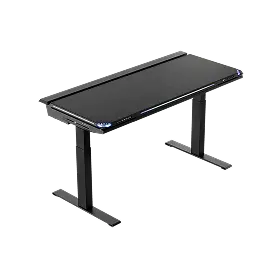
Blacklyte's approach to standing desk design reflects the same performance-first engineering philosophy behind their gaming chairs. The Atlas Standing Desk lineup is built for workstations that demand more than a basic lift-and-lower function. The Atlas Desk integrates a built-in power supply, magnetic cable management surfaces, smart RGB lighting, and control via Blacklyte's proprietary Atlas Driver software — features that position it clearly in the premium standing desk category, where dual motor performance expectations are the baseline, not an upgrade.
For those who want to compare desk specifications side by side before committing, Blacklyte's desk parameter comparison page lays out the key specs in one place. And if ergonomic positioning matters to you — which it should, given how much time a properly adjusted standing desk can save your back and neck — the Blacklyte ergonomics guide walks through ideal desk height calculations, monitor positioning, and posture alignment for both sitting and standing work. Matching a well-configured standing desk with an ergonomic gaming chair creates a setup that supports you across long sessions rather than working against you — which is exactly the pairing the Atlas Desk and Blacklyte's chair lineup are designed to enable.
If you're assembling a full gaming or work battlestation, the complete Blacklyte product range — including desk accessories like cable management and monitor solutions — is worth exploring as a cohesive system rather than piecing together individual components from different brands.
Frequently Asked Questions
Is a dual motor standing desk significantly more stable than a single motor desk?
Yes, in most cases. Dual motor systems provide active torque from both legs simultaneously, reducing lateral sway during lift cycles and at standing height. The difference is most noticeable on wider desktops, at higher height settings, and under heavier loads. For a large gaming setup with multiple monitors, the stability improvement is meaningful rather than marginal.
Can a single motor desk support a full gaming setup?
It depends on your total setup weight. A single monitor, laptop, keyboard, and mouse will stay well within most single motor desk ratings. Add a second large monitor, a desktop PC, a monitor arm, and a sound system and you're likely approaching or exceeding the rated capacity of many single motor frames. Always check the manufacturer's static load rating and leave a comfortable margin below the maximum.
Do dual motor desks require more maintenance?
Not meaningfully. The motors in a quality dual motor desk are sealed units that require no user maintenance. The control electronics handle synchronization automatically. What does matter is avoiding exceeding the rated load capacity, keeping the leg columns free of debris that could impede smooth telescoping movement, and avoiding impacts that could misalign the frame. These apply equally to both motor configurations.
How much height range do I actually need?
For most adults, a height range of 60–125 cm covers seated and standing positions comfortably, though taller users benefit from ranges extending to 128–130 cm or higher. If you're sharing the desk with someone significantly taller or shorter, a wider range and reliable memory presets make the transitions much more practical. Check the ergonomics guide for personalized height recommendations based on your own measurements.
The choice between a single motor and dual motor electric height-adjustable desk ultimately comes down to what you're asking the desk to do. Single motor designs are capable, cost-effective, and entirely appropriate for lighter, simpler setups. Dual motor systems deliver better stability, higher load capacity, faster lift speeds, and smoother operation — advantages that become increasingly important as your setup grows in size, weight, and complexity.
For a serious gaming or professional workstation, the dual motor configuration isn't a luxury — it's the engineering baseline that matches the demands of the equipment you're putting on it. Pairing that desk performance with a properly designed ergonomic chair, correct monitor positioning, and smart cable management is how you build a setup that actually supports sustained performance rather than just looking the part.
Ready to upgrade your setup? Explore the Blacklyte standing desk collection and use the desk comparison tool to find the right fit for your workspace. Have questions about which desk suits your setup? Contact the Blacklyte team — we're here to help you build something worth sitting (and standing) at.


